

As any successful leader knows, maximise performance and you’ll maximise ROI. This is especially true of workforces.
To do this you’ll need a profound understanding of the core competencies of everyone in the organisation.
Imagine you’re satisfied with the year-on-year revenue and growth of your organisation.
You’re hitting targets, but only just.
You believe that there’s a missing piece of the puzzle.
Something that once introduced would propel you to soar to greater heights!
Then, eureka! A moment of inspiration. It’s the core competencies of your workforce.
You’ve just discovered the value of a skills matrix.👌
What Is a Skills Matrix?
A skills matrix maps the core competencies people need to efficiently perform their roles.
Amongst many other things, skill matrices function as an actual visual operations record, allowing organisations to take a more strategic approach to project management, upskilling and, of course, L&D.
But they’re so much more than that. ❤️
A skills matrix provides a clear, actionable overview of an organisation’s workforce, allowing decision-makers the opportunity to optimise team structure and performance, plan effective L&D programmes, make the right decisions, align employee skills, and, ultimately, improve operational finesse, and organisational performance.
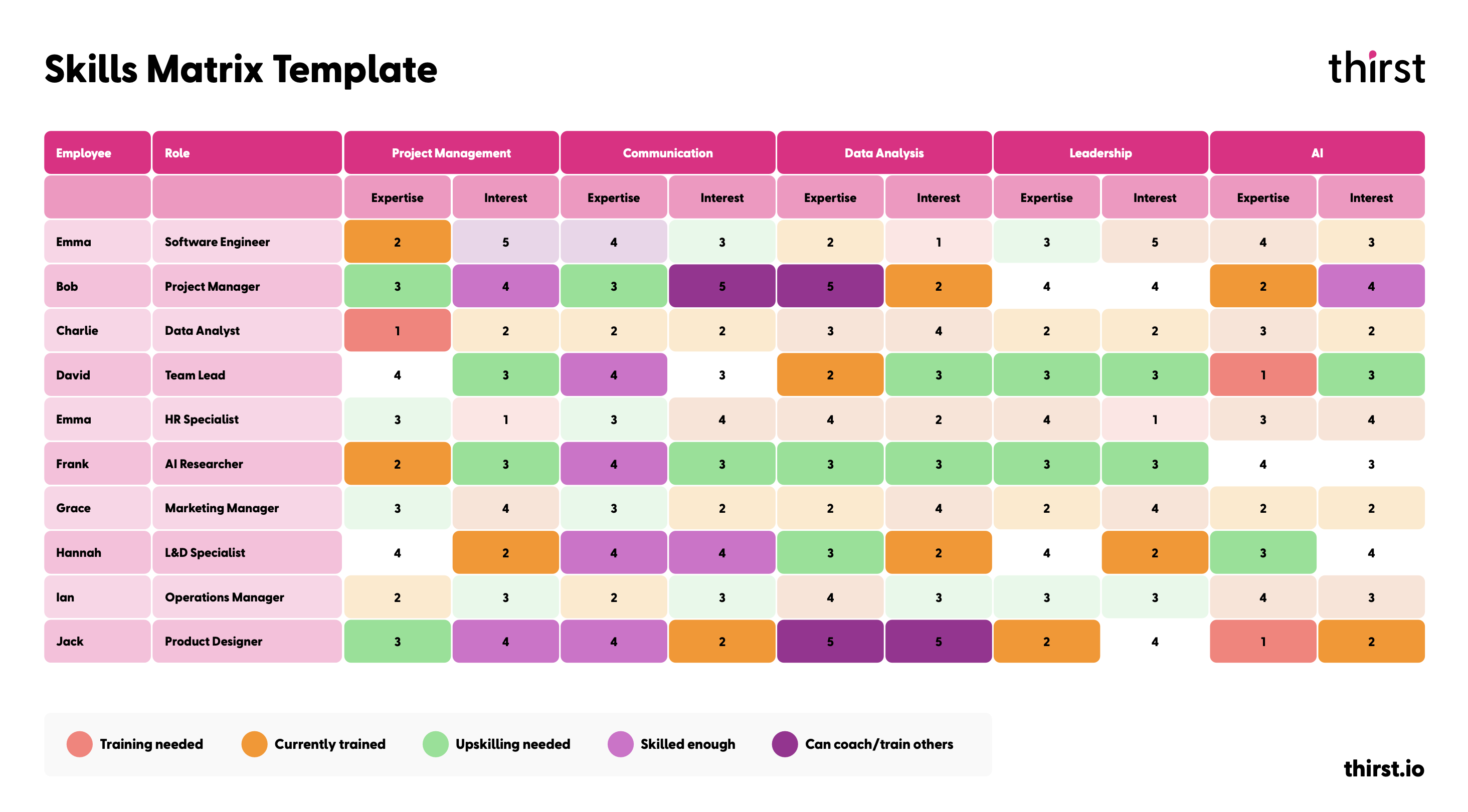
Best of all, skills matrices don’t need to be complicated. A simple table, like the one below, is a perfectly effective skills matrix!
For anyone who’s sat there, stroking their chin, still considering the benefits of using a skills matrix, then fear not, we’ll put all your concerns to rest.
Below is everything you need to know before you decide to leverage a skills matrix. 🙌
Why Is It Important?
Having a detailed understanding of the people, their roles, and responsibilities, and how your organisation functions as well or sparsely oiled machine, immensely benefits its overall performance – in quite a few ways.
From understanding areas of inefficiency to identifying new opportunities, skills matrices are the foundation for sound decision-making.
In simple terms, this allows organisations to monitor employee skills, accurately measure core competencies, gain valuable insights, identify upskilling opportunities, build solid foundations, and foster growth.
Without a robust skills matrix, one that identifies all the requisite attributes for sustained success, it’s nigh on impossible for organisations large and small to maximise performance and identify L&D opportunities.
Who Needs a Skill Matrix?
Skills matrices are primarily needed by HR departments, team leaders, managers, and of course, L&D professionals to leverage and make decisions that will enhance all areas of an organisation. 📈
Managers and team leaders can simply and effectively select the right people for specific projects, bolstering potential success rates before any actions have been taken.
Alternatively, L&D professionals can use skills matrices to maximise the impact of their learning and development programs and ensure everyone has the knowledge and skills to navigate their duties with finesse and easily scale their responsibilities.
Ready to Supercharge Your Organisation?
Sound good? Let’s get started!
We’ve put together a comprehensive explanation and step-by-step, easy-to-follow guide that explains what a skills matrix is, its benefits, how to create one + a FREE template, and an example template that you can feel free to use or adapt.
We’ve even listed the common mistakes to avoid, allowing you to optimise your workforce by gaining significant workplace insights into knowledge and performance and strengthening your organisation so you’re ready for future success.
Steal our free skills matrix template below…⬇️
and don’t forget to read the entire article below to learn how a simple skills matrix optimises your workforce.
How Does a Skills Matrix Map Employee Skills Against Core Competencies?
Okay, as you’ve no doubt guessed, skills matrices can transform your organisation’s performance. Let’s look at the individual steps to mapping employee skills against core competencies.
1. Identify Core Competencies
First things first, let’s look at identifying core workplace competencies.
After all, without knowing what your teams are and are not capable of right now, how do you know where to invest your L&D?
Examples of core competencies could be superior communication skills, proficiency in a particular software platform or ability to manage a large team of people. The table below may help:
|
Individual
|
Skill: Communication
|
Skill: Knowledge |
Skill: Adaptability |
Skill: Organisation |
|
Mary
|
7/10 |
5/10 |
8/10 |
9/10 |
|
Will
|
6/10 |
9/10 |
8/10 |
7/10 |
|
Charlotte
|
5/10 |
8/10 |
7/10 |
10/10 |
|
Tom
|
3/10 |
10/10 |
4/10 |
9/10 |
2. Define the Skills
Next, define, categorise, and score core competency skills, for instance, someone capable of using LLM’s, like ChatGPT or Google Gemini to a high standard will have superior technical skills. Someone who is adept at talking to all distinct types of people displays standout communication skills. 💻
3. Assess Employee Skill Levels
Now comes the time to assess the skills of each employee.
This can be formatted in a simple table (see above), or you can choose to be as comprehensive or meticulous as you like. Simply assign people, or whole departments, a skill level. This provides a clear insight into current performance and where L&D may be required. 🤔
Not sure how to effectively and efficiently assess people’s performance? Top tip: keep it simple. Try rating employees from beginner to expert, or beginner, intermediate and advanced, or rate out of ten.
Ask people to assess their own performance.
Encourage them to be honest about areas they excel in, and the areas they have shortcomings. Lastly, review performance data, comparing it with skills matrices. These insights make it easier to identify L&D opportunities.
4. Visual Mapping
Many of us take in vast amounts of information visually. It’s one of the best ways to help people better understand the bigger picture and even highlight the strengths and weaknesses people demonstrate.
Visually map your skills matrix and make it simple and easy for everyone to understand which aspects of a skills matrix relate quickly and easily to them.
This allows people to develop an easy-to-digest, yet comprehensive understanding of core competencies, linking skills with each. In fact, why not make it interesting? Colour code different skill levels to ease understanding and make decisions quicker. 🙂
5. Identify L&D Opportunities
Once the skills matrix has identified improvement areas, for example, leadership, communication, organisation, and even platform proficiency, you have an L&D framework to develop content that fills the knowledge gaps.
This is your opportunity to implement L&D initiatives that’ll have a notable impact on workplace productivity, happiness, and success.
6. Resource Allocation
Lastly, use the matrix to successfully allocate resources.
For example, if a team is without specific competencies, leaders can allocate resources, implement L&D, or hire people who have the expertise needed to help the organisation achieve its aims. 🤝
Benefits of Using a Skills Matrix
As you may have guessed, there are several core benefits to using a skills matrix, especially within the L&D department of any organisation. Neglect to employ one of the more fundamental processes to achieve short- and long-term success and you may just find yourself running to catch up as your competitors soar. 😲
Now, we’ve already alluded to a smattering of the benefits of using a skills matrix, but for clarity, let’s illustrate the benefits below.
Interested in learning how to level up your organisation’s performance? Keep scrolling.👇
1. Utilise People Who Drive Productivity and Success
First off, the main reason many organisations should invest in a skills matrix, is that it’s integral to identifying those people who are best suited to a role, project, or even specific task.
Some people excel working autonomously others in a team environment. That’s just the way it is. Identify which people excel in which environment, and in which circumstances, and you’ll drive productivity and organisational competence and success.
2. Identify and Fill Competency Gaps
Skills matrices are great at identifying gaps in an organisation’s team, department or even company-wide. This makes them ideal for addressing any lack of critical knowledge and skills, especially those your competitors possess.
Once these competency gaps have been filled, it’s so much easier to plan, execute and monitor
any new initiatives and achieve goals.
3. Bolster Organisational Strength
Any organisation is only as strong as the competence of everyone who works there. The more competent people are, the stronger the overall performance of the organisation will be.
Moreover, you can bolster organisational strength by identifying opportunities for people who’ll benefit from it and making sure that anyone can step up in the event of absence.
4. Monitor Employee Development
Skills matrices are integral to L&D departments, providing integral data and allowing organisations to make sound decisions, implementing successful programs where necessary. 📊
Better still, employees can use skills matrices to identify and address competency gaps and take initiative-taking steps to improve performance.
Moreover, a skills matrix serves as a career planning tool, one that helps managers and HR professionals make competent decisions to advance their careers.
5. Employing the Right Candidates
Employing the right candidates is crucial to optimising performance.
This is especially important to ensure a seamless transition when candidates leave roles.
Using skills matrices makes it easy to identify and employ the right candidates for the right roles, even making quarterly or longer forecasting easy, effectively anticipating the needs of your future workforce. 😮
6. Monitor Employee Competence
Use a competency matrix and you’ll be able to monitor high-value employee performance, identifying any L&D opportunities to further bolster their skillsets and value to the business.
Additionally, recognising and rewarding these individuals ensures they remain satisfied and engaged, helping to guide decision-making, including recognition and promotions.
How to Create a Skills Matrix
Now we’ve learned what a skills matrix is, why it’s important, how it measures core competencies against upskilling potential and, lastly, the benefits of creating one that meets your organisational requirements, it’s time to create one!
But where do you start? Below is an overview of how to create a skills matrix. Follow these steps and you’ll gain significant insight.
Step One: Define the Purpose of Your Skills Matrix
First things first, you need to define the purpose of your skills matrix. Decide exactly what you want to achieve. The good news is that skills matrices can be adapted and tailored to a broad range of purposes.
Unsure whether a skills matrix is suitable for your organisation? We’ve got the lowdown for you below: 👍
Identifying skills gaps: the first one is obvious, but that doesn’t mean that it’s any less important. In fact, it may just be the best way for organisations to gain valuable insight into everyone’s performance, identifying areas that would benefit from L&D.
Align with organisational goals: now that you’ve identified knowledge and skills gaps, the next stage is to make sure that it aligns with the short-and-long-term goals of your organisation. This allows you to make shrewd decisions which improve everyone’s working environment.
Once you’ve identified the skills gaps and compared and aligned them with what your organisation hopes to achieve, you have the purpose of your skills matrix. And it’s time to move on to the next stage.
Step Two: Identify Key Roles and Skills
Now it’s time to take a deep dive into the performance and efficiency of the organisation.
This can be as general or as meticulous as you’d like, however, we’d recommend that you take more than a cursory look at what’s working and where there’s room for improvement.
Start by listing the key roles in your organisation, from the person with the least decision-making responsibility to the most. Are their day-to-day responsibilities optimised? Could their time be better utilised? Would they benefit from considered L&D? These are just a few of the questions that you should be asking.
Compare the answers against core organisational influences, including influence, revenue growth, cost-savings, ability to perform all aspects of their role and hey presto! You’ll get a clear idea of the key roles and skills present and missing across all areas of your workforce.
Step Three: Define Proficiency Levels
Next, it’s time to define employee efficiency levels. This is critical to understanding how adept people are in their individual roles. Why? The more proficient someone is, the better they will be at meeting the day-to-day, short-and-long-term objectives of their role.
Have they been set sales targets? Cases closed? Cost savings? L&D course completion rates? Employee turnover rates? Social media campaign engagement rates? Product defect percentage? There is a wealth of metrics to use.
Be sure to tailor metrics to individual, department or organisation-wide performance, or metrics most appropriate to circumstances and goals.
This requires performance insights. It’s probably a wise idea to talk to line managers, review 1-2-1’s, look at how they’ve performed over a prolonged period, and compare their performance against your expectations.
But how do you score proficiency levels? Easy. You could choose to keep it simple, giving each employee a score out of five or grade from A-E. You could give employees stars out of ten. Maybe compile the data into some sort of visual representation, such as a chart or graph. The choice is yours!
Want to keep it simple? Why not follow the simple structure below:
1-Beginner
2-Intermediate
3-Advanced
4-Expert
Simple. Easy to follow, score and calculate.
Step Four: Assess Employee Skill Levels
So, how do you assess employee skill levels?
Easy, there’s a wealth of ways to gain an understanding of how skilled employees are–and areas where they’d benefit from further L&D.
The good news is that assessing employee skill levels doesn’t need to be an arduous or complicated process. In fact, it’s quite straightforward. It just requires a little understanding of how to evaluate employee skills in a way that maximises insight.
Popular methods include:
Self-assessment surveys: this gives employees the opportunity to reflect on their own performance, identify or recognise their strengths and weaknesses, set personal development goals, take ownership of their professional and personal growth, and much more, including giving managers valuable insight into how different people perceive their own performance, allowing them to plan and execute L&D programs.🥇
Manager feedback: there are few things more pivotal to the perception of an employee’s performance than a manager’s feedback. When measured fairly and accurately, this feedback can be both a motivator and provide valuable insight into areas where there’s room for notable L&D opportunities. 📣
Imagine for a moment that you believe yourself to be performing well. Hitting your targets. Yet that team leadership opportunity you’ve been gunning for hasn’t been as easy to obtain as you’d like.
You get feedback from your manager and discover that your leadership skills need polishing. Great! Now you have an opportunity to undertake L&D and hone your skillset.
Performance and Data Analytics: to truly hone your L&D insights and level up everyone’s skillset, using data analytics to measure and improve performance is essential.
Whether you’re aiming to prioritise training, make informed talent forecasting decisions, or even visualise trends, there are few better ways to pinpoint actions you need to take than by employing data analytics to effect positive performance.
Best of all, data analytics is completely objective, avoiding any bias, whilst encouraging continuous improvement, even allowing for L&D evolutions which can further improve strategies to leverage to achieve greater results than ever before.
Step Five: Visualise the Data
Any data is only as good as its ability to be understood–and applied to benefit everyone who’ll use it to make informed decisions–which is why data visualisation is paramount to any successful skills matrix.
Not sure how to do this?
Well, a good place to start is to consider the learners you’re hoping to upskill.
Remember, some people are kinaesthetic learners, i.e., they acquire knowledge through physical activity.
Others are auditory learners, i.e., they listen and absorb information like sponges. However, a lot of people are visual learners–their L&D is best suited to visual cues, e.g., graphs, charts, and diagrams.
Interested in levelling up your visual L&D? Why not leverage AI to gain a more comprehensive understanding of the key data components?
This allows for automated skills tracking and identification of new L&D opportunities.
This could be a game-changer if you’re looking to get ahead of the competition and stay there. And Thirst has you covered!💡
Step Six: Identify Gaps and Take Action
Now comes the fun part: identifying gaps and taking the appropriate steps to level up your L&D!
This step is integral to getting the absolute best from your L&D and optimising your workforce.
Let’s say that you believe your workforce’s lackadaisical interdepartmental communication skills have ruptured client relationships.
Perhaps account managers have failed to communicate something as simple as client requirements and this has compromised the relationship. This presents a clear upskilling opportunity.
Invest L&D into improving interdepartmental communication, evolve processes, stress the importance of working together as a team and voila! Problem solved.
Be sure to prioritise upskilling and training initiatives according to the immediate or long-term impact they’ll have.
If there’s a gaping hole in your performance, for argument’s sake, let’s say that you’ve suffered from poor product quality, unsatisfied customers, and compromised brand reputation, then implementing new QC processes might be advisable. 🫡
Remember, for maximum impact, be sure to link L&D programs to personal growth. This is how you’ll motivate and inspire people to strive to get better.
Why not make L&D a core, compulsory part of everyone’s professional development? This is a fantastic way to encourage everyone to get better whilst simultaneously improving organisational performance!
Step Seven: Keep It Updated and Scalable
The last step is the one that’ll drive your business into the future: keeping everything simple and scalable. Complicate a skills matrix with too many unnecessary variables and you’ll risk diluting the desired impact.
But it’s more than that.
Complex skills matrices are more difficult to scale than simple ones. Any organisation with an eye on growth and success should ensure that their skills matrix reflects their ambitions.
What good is including proficiency in, let’s say Microsoft Dynamics CRM, if everyone’s using ClickUp? How effective is retraining everyone on their phone manner if most customer communication is completed by AI chatbots?
Simple and scalable skills matrices are efficient. This makes it so much easier for organisations and their personnel to comprehend, access and update whatever they need to, without getting bogged down in excessing details which can compromise swift decision-making, operational forecasting, and L&D.⬆️
So, we’ve already shared a basic template, one that outlines the basic core skills that employees of any organisation need to successfully navigate day-to-day responsibilities and opportunities to excel in one’s career, both professionally and personally, now let’s look at a template that gets to the core of just how beneficial a skills matrix template is.
Common Mistakes to Avoid When Creating a Skills Matrix
Like anything else, creating a skills matrix isn’t without its perils and pitfalls. Avoiding these will help you to optimise matrices performance, allowing you to gain significant, actionable insights to inform your L&D and improve organisation-wide performance.
Interested in learning the mistakes to avoid when creating a skills matrix? Keep reading below:
Not Regularly Updating the Matrix
Any matrix is only as effective as its relevancy. This is true regardless of the simplicity or complexity of the matrix. Too many organisations make the mistake of creating a skills matrix and failing to update it as their organisation evolves.
The result?
Poor decision-making. Remember, the dynamics of a successful organisation change, and evolve, and so too should its people and their skills.
Therefore, by not updating your skills matrix regularly, you’re making the mistake of not aligning your current objectives with your actions. 📚
Overcomplicating the Structure
This is a pitfall that some of us fall into: making the skills matrix structure too overcomplicated. It doesn’t need to be!
Our table on the How Does a Skills Matrix Map Employee Skills Against Core Competencies? section proves this.
Does your skills matrix need to be this simple? Not really.
You can make it as simple or complicated as you like. But overcomplicate the structure and people will struggle to understand and adhere to it.
Remember, any L&D skills matrix can serve as an indication of how your organisation can, will and should evolve to meet your future goals. Overcomplicate the structure and you’ll risk not meeting those goals.
Ignoring Soft Skills
Developed soft skills are paramount for communication, collaboration, leadership, conscientiousness, and general workplace harmony. Ignore the importance of soft skills at your peril!
An efficient, robust workforce, one that is adept at seamlessly performing all the duties required of them, has all the requisite hard–and soft skills. Ignoring developing soft skills like, for instance, communication, can lead to breakdowns and issues that can have a negative knock-on effect.
If you want to hone your organisational prowess, invest L&D into hard and soft skills.
Failing to Pair People’s Skills to Organisational Goals
This sounds obvious, right? Yet, you’d be surprised just how often organisations fail to pair people’s skills to the short-and-long-term goals of the organisation.
Remember, a skills matrix only reveals insight. If you don’t follow up the insights gleaned with appropriate action, it’s pointless completing a skills matrix in int first place.
What does this mean?
Let’s say that you’ve conducted a skills matrix and uncovered that your technical team’s interpersonal skills could be improved. Great! You now have an L&D opportunity! 🙌
Not only will this help their professional growth, but upskilling people will strengthen the organisation.
Succinctly communicating dense, complex, or jargon-rich information in a simple and straightforward way is a real talent–and something that some people find challenging. Upskill people and you’ll upskill the organisation, helping you to achieve your goals.
Using Subjective Assessments Instead of Data-Driven Insights
If you want to make sound, actionable decisions, use data-driven insights. Subjective assessments and opinions are flawed. Why? They’re based on perspective. Not fact.
A smart organisation relies on data insights. Remember, data doesn’t lie. It’s as clear, and objective as can be, provided it hasn’t been corrupted, of course. 🫢
Consider something as simple as YouTube views.
Each time a user clicks play on a video and watches it for at least 30 seconds, a single view is recorded. Repeat viewings of more than 30 seconds also count as a view. The more views, the more popular the video is.
Now imagine that you’re talking to a friend. They tell you that you simply must watch that video. It’s blowing up on social media. But there’s no data to back up the claim.
This is a subjective assessment. An opinion. And whereas it may be somewhat accurate, it’s not as accurate as any clear, undeniable data that demonstrates the accurate, real-time number of page views.
Final Thoughts
Every organisation must have a skills matrix. It’s really that simple. It provides a clear, visual overview of the skills and expertise your workforce has–and needs to cultivate. The insights can be transformed into actions which improve specific areas of the workplace, helping organisations achieve their short- and long-term goals.
From identifying L&D initiatives to future forecasting and, ultimately, vastly improving organisational efficiency and success, a skills matrix is your window into what you’re capable of achieving right now and what you could achieve when you pinpoint specific ways to improve, well, pretty much any area of your organisation! 😀
Moreover, incorporating a skills matrix into your HR and even L&D actions can empower people to acquire and develop new and existing skill sets. This can have a significant impact on operational performance, helping them achieve even the loftiest ambitions.
Sound good? Download our FREE skills matrix template today and elevate your performance.
Got 2 Minutes?
If your organisation is struggling with disengaged learners, Thirst has the solution.🔥
Thirst is an AI-powered learning platform that helps L&D teams of all sizes boost learner engagement and create experiences tailored to today’s learners.
Take a guided tour today and see Thirst in action.
For more e-learning insights, resources and information, discover the Thirst blog.
You may also enjoy:
What is Bloom’s Taxonomy? Definition, Benefits & How to Apply It | Skills-Based Organisation Playbook: Steps to Become One | What is the ICE Framework? Scoring Method Explained